Diving
Pictures
A peek into the underwater
world for divers and non divers alike.
I
will be updating this section whenever I put my camera under the waves.
My intentions are to provide
a visual description of the things I see underwater through my photos
and video, helping people to have a better understanding of what scuba
diving is all about, how diverse the sport is, the flora and fauna of
different bodies of water, as well as educating about the rich history
we have in our shipwrecks right here in the Great Lakes.
click the images below to open that gallery.
If you don't see text links on the left side of the page click here!
Best
Wrecks of 2011 - 38 images
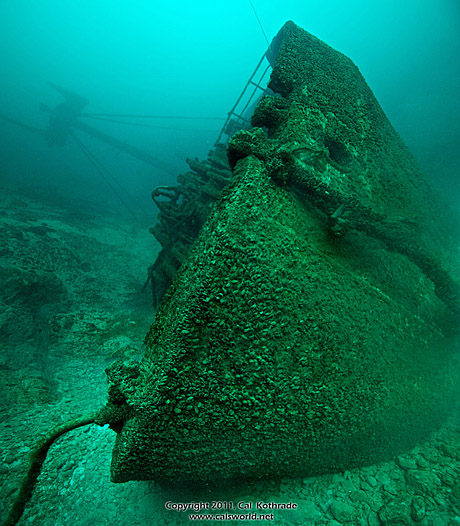
The 2011 diving season had many weathered out dives for me personally, but despite the lost dives, I did get my camera on some wrecks for the first time, and had several dives of particularly exceptional visibility. Namely, the images shot of the Willie on July 6th, and the final images I took of the Norland late in the season. All in all, I was able to get good shots of the Lumberman, Barge Transfer, Norlond, Carferry Milwaukee, Frank O'Connor, Prins Willem V, and the Wisconsin. All are from Lake Michigan, ranging between Sturgeon Bay in the north and Cudahy to the south. Some of the images are taken from locations or angles not usually photographed, perhaps giving the viewer a fresh look at an old friend. The above image was featured on the cover of Midwest Dive News, February 2012, and was the product of 4 separate stills manually stitched together in PhotoShop to provide a larger image than what would have otherwise been possilbe. The image of the Wisconsin entitled "Wisc.Mosaic.jpg", and the image of the Norlond port hull entitled "NorlandMosaic.jpg" are multi image mosaics as well.
___________________________________________________
GLSRF
Norlond Project, Summer of 2011 - 100 images

Summer of 2011 afforded
me 3 dives on the wreck of the Norlond, two of which were with Great Lakes
Shipwreck Research Foundation as a volunteer photographer. My mission
was to get shots of other volunteers working on their drawings, measurements
and so on when the vis was poor. When the vis was above average I was
charged with getting the best possible pics of a difficult wreck due to
it's location and normally turbid water. I was lucky enough to be present
on what was the night of the best vis on the Norlond I have ever seen.
50 foot plus vis helped make for some great shots. I would like to thank
Kimm Stabelfeldt for the standing invitation every week, and also thank
you to all the volunteers I dove with, a pleasure as always!
All images are copyrighted and may not be used without permission.
___________________________________________________
September
1st , 2011 - 47 images
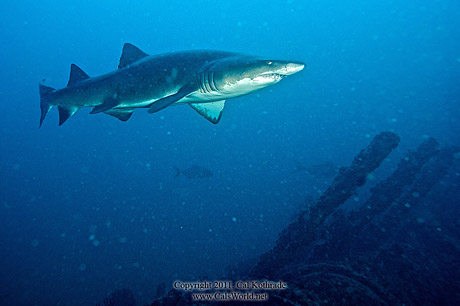
One week before Hurricane
Irene struck the East coast of the U.S., I traveled to Hatteras, North
Carolina with five friends for a week of sunny, prisitine diving.
They call the patch of Atlantic ocean off of the Outer Banks "The
Graveyard of the Atlantic". There are hundreds of shipwrecks along
this unassuming coast, many of which are war graves, having been put on
the bottom by German U-Boats. We did 10 dives in 5 days aboard the incredible
dive boat "Flying Fish", operated by Captain Jonny Pieno. His
lovely wife Amy runs the dive shop, "Outer Banks Diving" in
town. My friends and I can't say enough about the great people we encountered
on this trip. The wrecks are not as intact as we are used to here in the
Great Lakes, but instead have morphed into vibrant healthy reefs, which
made for great critter hunting and close-up photography.
_________________________
February
12 -13th, 2011 - 4 images

Diving under the ice
of an inland lake can provide visibilities far greater than at any other
time of year, and it offers up stunning views of light patterns and air
pockets that block out light. It requires specific training and some special
gear to stay warm, but is well worth the effort. I chose 4 stills excerpted
from Hi-Definition video I shot in preparation for a short documentary
about ice diving, due mostly to the incredible light show the snow covered
ice, an open hole and a sunny day gave me. Location was Lake Nagawicka,
in Southern WI.
___________________________________________________
Best
Wrecks of 2010 - 40 images
The 2010 diving season
was a great one with good weather and calm seas most of the time. Visibility
in the Milwaukee area was less than it has been in years past in my opinion
but the water temps seemed warmer than last season too so it all evens
out I guess. I have chosen 40 various images from 6 different wrecks I
visited on Southern Lake Michigan, ranging between Port Washington
to the north and Chicago to the south.
___________________________________________________
August
11th -16th, 2010 - 73 images
I've been wanting to
dive the Pacific Northwest for several years now, and this was the year
that I got to do it. Along with my dive buddy Tim Stilwell from Iowa,
I trekked two suitcases full of coldwater dive gear, and one 33 pound
underwater camera system to the other side of the continent in search
of the "Emerald Sea". We would stay at a 'dive resort' at the
northern tip of Vancouver Island in British Columbia, Canada. Browning
Pass Hideaway is owned by John DeBoeck, a regional legend who is widely
know as the most knowlegeable sea captain and dive guide on the western
coast of Canada. His passion is putting divers in the water at his favorite
sites and doing it at excactly at the right time. All of the diving in
this region is subject to the tides. You can only dive most of these sites
at slack tide, the short window of opportunity between flood tide and
ebb tide. This is when the waters slow down enough that divers (especially
ones with cameras) can safely enjoy the dive. On many of our dives the
beginning of the dive we would be going North on the ebb tide and halfway
through our dive the drift would change back to the South and the beginning
of the flood tide would take us back the way we had come. All the while
John is on the surface watching our bubbles, and diligantly keeping track
of where everyone is like a mother hen. When you are down to 7 or 8 hunderd
pounds of air in your bottle you head for the surface and begin your safety
stop. If you are at a site where you are near the Pacific Bull Kelp you
can hang out and look for little crabs or small Cross Jellyfish near the
surface. John picks you back up in the dive skiff wherever you may pop
up once you remember to give him the diver OK signal. Because all dives
are centered around slack tide, we generally will only do one dive from
the skiff, then go back to the Hideaway for a delicious homecooked meal.
Dives will typically have about 3 hours between them, and there is always
time to get some food or a nap before suiting back up and taking your
place on the skiff for another dive. We did 3 dives a day as a rule, sometimes
4. Water temps ranged from low to mid 40's F.,and vis stayed pretty steady
around a hazy 25 ft. If you are shooting macro, none of this really matters
though. All the dives are a 'free ascent' meaning that there is no anchor
line to come up but you usually will have a life encrusted wall to use
as a visual reference if you need it and often times the kelp serves as
a line to hold onto if your buoancy is not right or you don't want to
drift in the current. Depths range from surface to past 150 feet, (the
pass is an average of 1300 feet deep) but the best zones are between 50
and 90 as this is where the largest variety of life can be found, as well
as better vis below 40-50 feet. I found it a good mix of benefits to keep
my dives 50 to 80 feet to conserve on gas and make the most of my all
too short stay in this wildly beautiful place. Rides to and from the sites
are short as the Hideaway is perfectly placed in a calm and protected
bay on Nigei Island, just minutes from all the best sites. While traveling
to our sites we routinely saw more than one American Bald Eagle, Sea lions,
Kingfishers, and on the last day the fluke of a mother Humpback Whale.
One also needs to keep an eye out for the ever possible Orca or Whitesided
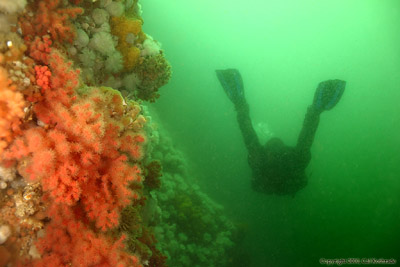
Dolphin sighting. Under the water many of the dives are on immense vertical
walls that are covered in layer upon layer of every conceivable form of
life. As you slide by this kaleidoscope of life on the gentle slack current
you can look down and watch the wall fade away into the darkness. The
water is the most incredible green and it only takes one dive to see why
the region has been coined the "Emerald Sea". The proliferation
of life here is staggering, from the forests of giant Plumose Anemones
to the huge schools of Rockfish that play in the kelp. Decorator and Hermit
Crabs are everywhere, as are other larger creatures such as Ling Cod,
Puget Sound King Crabs, Octopuss, and Lions' Mane Jellyfish. Though I
did not get the chance to be greeted underwater by a Sea Lion, I did manage
to check off nearly all of the creatures on my 'need to see' list, with
the exception of the Wolf Eel, with the face only a mother could love,
but my dive buddy Tim did get to see one for me on one of the many dives
we unintentionally separated due to both of us being so glued to our cameras'
viewfinders.
In summary, my nine day trip was really more an oddyssey than a trip. I learned so much about the flora and fauna both above and below the water from such incredibly nice local people who were only too willing to enhance my visit to this diverse ecosystem with vivid stories and insightful information about the things I was seeing through my lens. A stay at the Hideaway is a life changing event for some I would think. It was for me. I wanted to dive and what I got was simply the best diving the BC area has to offer by perhaps the best guide to ever ply it's waters. This is what was told to me by everybody that I met that was a local, both in town and at the Hideaway. John, would never claim these things though. I found him to be most humble, and patient. He is always at a loss for words when a diver comes up from a great dive and says, "John, that was incredible, thanks!" His position is this: "I didn't carve out these underwater canyons and plant the anemones, I just nail the slack occasionally".
I didn't have a single bad dive, and it was worth every penny. One word sums it all up. Go.
Read my article "In Search of the Emerald Sea" as printed in December issue of Midwest Dive News Magazine.
___________________________________________________
July
11th, 2010 - 15 images

I had an opportunity
to catch a ride on my favorite dive boat the Len-Der while it was 30 miles
north of Milwaukee in Port Washington, WI, this past weekend to
go see the wreck of the Northerner. She sank in 1868, no lives
lost, foundering in a storm several miles southeast of Port Washinton,
WI. 81 feet in length, 18 foot beam. She was a wooden two masted lake
schooner used for transporting of goods, in the case of her final voyage
she was carrying cord wood. Still in incredible condition due to depth,
130 plus feet to the sand, which keeps storms from doing much damage.
My dive partner Adam and I were the first ones down the line and found
pretty good visibility for late afternoon under complete cloud cover and
1-2 foot choppy waves. (very little natural light) Water temp at bottom
38 F. Time alotted at depth 13 minutes. Visibility approx 50-65 feet.
Camera- Canon T1-I Rebel, canon EF 18mm IS lens. ISO 800, 1/80 second
shutter, f 3.5
__________________________________________________
June
19th, 2010 - 16 images

This
is not the first time I have posted images of the Carferry SS Milwaukee,
but it is the first time I have good images to show you, thanks to my
new underwater camera setup which does much better with the low levels
of natural light in the Great Lakes. One dive on the stern and one on
the bow yielded some great shots of the pilot house that blew off during
sinking due to air pressure and finally came to rest on the lake bottom
about 80 feet away from the port bow as well as the stern with it's famous
bent seagate and large props.
___________________________________________________
March
27th, 28th, 2010 - 43 images
A 400
mile drive southwest of Milwaukee will find you in Bonne Terre, MO,
about 60 miles south of St. Louis. A sleepy little town with a big hidden
treasure...the largest man made caverns in the world. These mind bending
underground spaces are courtesy of a now defunct lead mine. What once
was the largest lead mine in the world is now a mecca for scuba divers.
When shut down in 1962, EVERYTHING was left behind and the pumps that
had kept it dry for 100 years were turned off. Natural ground water rose
thereby creating a watery time capsule. Purchased in the 1980's, it was
turned into a divable lake. Guided trails start at the water's surface
more than 100 feet below ground. We did 3 dives on Saturday, and 1 on
Sunday morning before returning home from an incredible weekend of underground
cavern diving. This place has been dived and filmed by Jaques Cousteau,
and covered by various documentaries, most recently the "Life After
People" series. Bonne Terre has been on my "dive radar"
for nearly 10 years since I first read about it in a scuba magazine but
until now I never had a group to share the experience with. If I had known
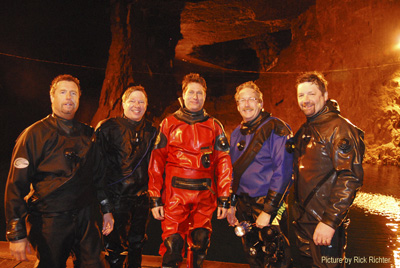
how bizarr the mine was I would have gotten there sooner. In the picture
are my traveling companions and fellow Buccaneers, Scott bruss, Brian
Bockholt, Dirk Wilhelm, and Dan Vandorf. Known as "Team Wilhelm"
(Dirk was the first to sign up and also the first to volunteer to drive)
we met up with 7 other friends from Milwaukee known as "Team Richter".
One cannot dive alone, nor can one dive trail 2 until they have dove trail
1and so forth and so on. With trails 1-4 under our belts, we will come
back next year and move onward to the ever more challenging trails 5-8.
There are 24 trails at the mine, each one progressively becoming more
challenging from a technical standpoint, something like a video game.
I apologize in advance for the lack of any really breathtaking underwater images. I'm afraid my camera and I were outmatched in this very low light level setting. Our eyes could register the faint light and enormous vistas but our cameras were incapable of capturing the grandeur and scope of this underwater time capsule. Perhaps next year I will be equipped with better gear and up to the challenge of bringing back the images we saw while diving Bonne Terre's Billion Gallon Lake.
___________________________________________________
November
9 th, 2009 - 27 images
5 days
in Mexico's Yucatan penninsula just a few minutes north of Playa
Del Carmen provided me with the chance to do two dives in the spectacular
hidden sinkholes of the Mayans known as Cenotes. Mario from "Dive
Aventuras" in Puerto Aventuras, was an incredible dive
master making sure I was safe as well as having a good time. It was just
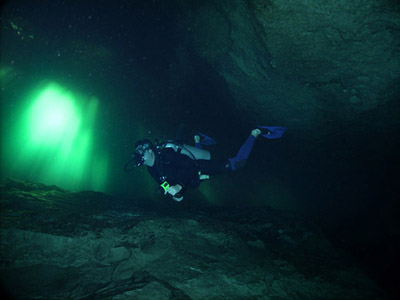
the two of us and several times he took my camera from me at specific
points along the route to take my pictrue with the light streaming in
from the surfaces where the caverns open up to the jungle above. These
underground caverns and caves are filled with fresh water so clear you
think you're diving in air. Visibility can range from 75 to as much as
150 feet.
I dove two cenotes connected by a shared entrance know as "Little
Brother". Once you have walked down the steps into the small room
you ease into the water and can go to your right for Cenote Kukulcan,
or to your left for Cenote Chac Mool. Water temps were around 76 F in
the fresh and when below 40 feet or so the invading seawater was closer
to 80 F. Chac Mool has an impressive air dome with tree roots and stalagtites
hanging down into the water. Fossils could also be found embedded in the
limestone.
I cannot stress enough what a fantastic dive guide Mario was. He is a
bit of a local legend, having sherpa'd for some very famous cave diving
explorers as a young child before being taken under their wing. He is
now a certified cave diving instructor as well as acomplished discoverer
of new cenotes in his own right, often diving whereno human has ever been
before. This is the man you want taking you in these potentially dangerous
areas if you are not cave certified yourself. He can be found here.
For more information on the formation of cenotes and maps of the two I dove click here.
___________________________________________________
October
13-15th, 2009 - 57 images
A week
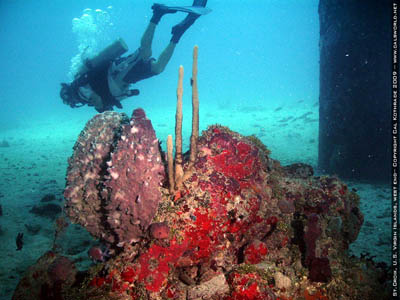
in St.Croix, U.S. Virgin Islands yielded among other things, 8
dives and 2 very good snorkels with my wife. 6 of the dives were on the
West End (my favorite), and provided me with some really great
patch reefs, sloping reefs, wrecks and quite possibly the best dive site
in the Caribbean for macro opportunities, the world famous Fredreksted
Pier. On the last day I did two dives on the north coast, both just
outside the harbor of Christiansted. All dives were boat dives
provided by S.C.U.B.A., I would like to say that they are truly
the friendliest dive shop, well equipped, and great to dive with. Thanks
to my dive masters Ross, Greg and especially John, who without his expert
eye, many of these macro shots would never have happened because I would
never have spotted the creatures on my own. Hundreds of pictures were
taken but I somehow narrowed it down to 57 for this website. Please don't
forget to click on any image to see the larger, higher resolution version.
___________________________________________________
September
5th, 2009 - 22 images
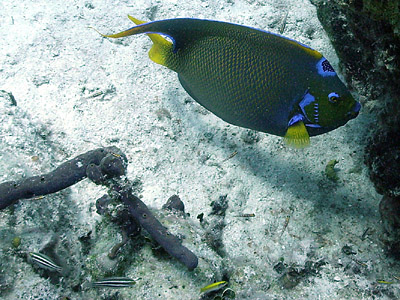
Two
really nice dives with Stuart Cove's out of Nassau, Bahamas over
the Labor Day Holiday weekend. First dive was to the 50 foot deep wreck
of the David Tucker, a 95 foot steel hulled Coast Guard Patrol
Boat built in Maryland in 1953, sold to the Bahamas in 1989 and consequently
struck and sunk. We started and ended our dive with this great wreck,
and in the middle managed to insert a nice vertical wall which was only
75 yards or so away, where we got down to about 75 feet. The second dive
was nearly an hour long in 25 feet of water where we saw many beautiful
patch reefs and the twin engined Cessna airplane that Michael Caine's
character crashed into the sea in the movie "Jaws 4". The final
day of our vacation was spent walking about on Ocean Drive in South Beach,
Miami where I was able to catch a nice pic or two of the local architecture
and a vintage Buick.
___________________________________________________
July
24th-25th, 2009 - 18 images
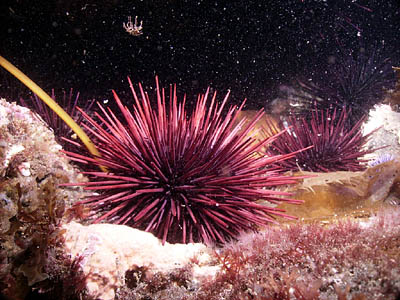
Two
incredible days of diving Southern California's kelp forests. 3
dives from The "Spectre" Dive boat at Anacapa Island
and 2 shore dives at Casino Point Dive Park at Avalon, Catalina Island.
Vis 15-30 feet, heavy current and surge more often than not, and water
temps in the 60's. Depths 25-70 ft.
This movie is a 25 minute documentary about diving the Kelp forests of Catalina and Anacapa Islands as seen through the eyes of two midwest wreck divers. 100 still photos are used along with 20 minutes of video and narration all put to an original soundtrack by Stingray Studios to chronicle the 4 day whirlwind divetrip above and below the waves in Los Angeles taken by myself and my dive partner Rob in mid July of 2009.
This
DVD can be purchased for $10.00
Part one -8 minutes
Part two-8 minutes
Part three-9 minutes
___________________________________________________
July
4th, 2009 - 7 images

A fantastic
shore dive at Lake Michigan's Bender Park including fish and crawfish.
We were under for well over an hour in the shallow water. Max depth about
20 feet, water temp 52 degrees F. Visibilty about 20 feet.
Watch
the movie now!
__________________________________________________